What Makes a Baseball Card an Official Rookie Card? The RC Logo Explained
The small RC stamp settles the question for modern cards. It does not settle it for a 1951 Bowman, a 1st Bowman prospect card or a 1980s Traded set. Here is what the logo means, where it came from, and how to check a card yourself.
Published
Short answer: since the 2006 sets, an official baseball rookie card is a player's first licensed base card after his MLB debut, and it carries the RC logo. Cards made before 2006 never had a logo, so their rookie status rests on hobby consensus. Prospect cards such as 1st Bowman issues come out before the debut and are not official RCs, even though the market often values them higher.
The RC Logo: Where It Came From
Before the 2006 baseball season, the MLB Players Association announced changes meant to make rookie cards easier to define, according to Cardboard Connection. Sports Collectors Digest reported the core of the plan: rookie cards would receive a rookie-card logo that collectors would be taught to look for, beginning with all 2006 sets. Rookie cards would stay in the main set, and minor leaguers in Bowman products would appear only as inserts, so price guides would no longer label them rookie cards.
Coverage at the time described eligibility in terms of reaching the majors: Cardboard Connection says official rookie cards were made only after a player appeared on a team's 25-man roster, and SCD described rookie cards as base set cards from the first season a player is called up to his major-league team.
Topps' current explanation is simpler. In its rookie card crash course, Topps defines an RC as a player's first professional card after his MLB debut, marked with the RC stamp, and says a player only needs an appearance in an official game to get one: one at-bat, one out in the field or one pitch. Topps adds that it tracks call-ups with guidance from MLB and the MLBPA.
Which Players Get an RC, and in Which Set
Per Topps, any player who appears in an official MLB game qualifies, but the card does not always land in the set collectors expect. Topps says production takes about 50 weeks from design to shelf, so the product a rookie card appears in depends on whether the debut beats that product's cutoff. According to Topps, a flagship RC can live in one of three products:
| Topps product | Whose RC it typically carries (Topps' 2024 example) |
|---|---|
| Series 1 | Players who made the opening day roster or were called up in April or May of the season before |
| Series 2 | Late-season call-ups (September, playoffs) and international signings from the season before, plus some April and May debuts |
| Update Series | Player movement in the first half of the season; some high-profile players who debut early get their RC here in the same calendar year |
Topps notes that cutoff dates for all three products change from year to year, so check the checklist for the specific year rather than assuming.
Why Some "Rookie Cards" Have No Logo
The pre-logo era
The logo only reaches back to the 2006 sets. Everything earlier relies on agreement among collectors, catalogs and graders. Cardboard Connection describes the older standard as a player's first fully licensed base card for a given brand in a single year, which is why one player can have several. It gives Randy Johnson as an example: his 1989 Topps Traded and Score Rookie & Traded cards are not rookie cards because he already had base cards in earlier releases.
The clearest pre-logo case is Mickey Mantle. PSA's CardFacts page calls the 1951 Bowman Mickey Mantle #253 the only recognized rookie card of Mantle, and notes that the 1952 Topps Mantle receives a tremendous amount of fanfare without being his rookie.
Prospect and minor-league cards
The second group without a logo is cards made before the player reached the majors. Under the 2006 plan, SCD reported, Bowman minor leaguers became inserts that price guides would not call rookie cards. Cardboard Connection describes Bowman prospect cards as a separately numbered insert set that looks like rookies except for a numbering difference on the back and one missing logo, and notes the market often values them above the official RC anyway.
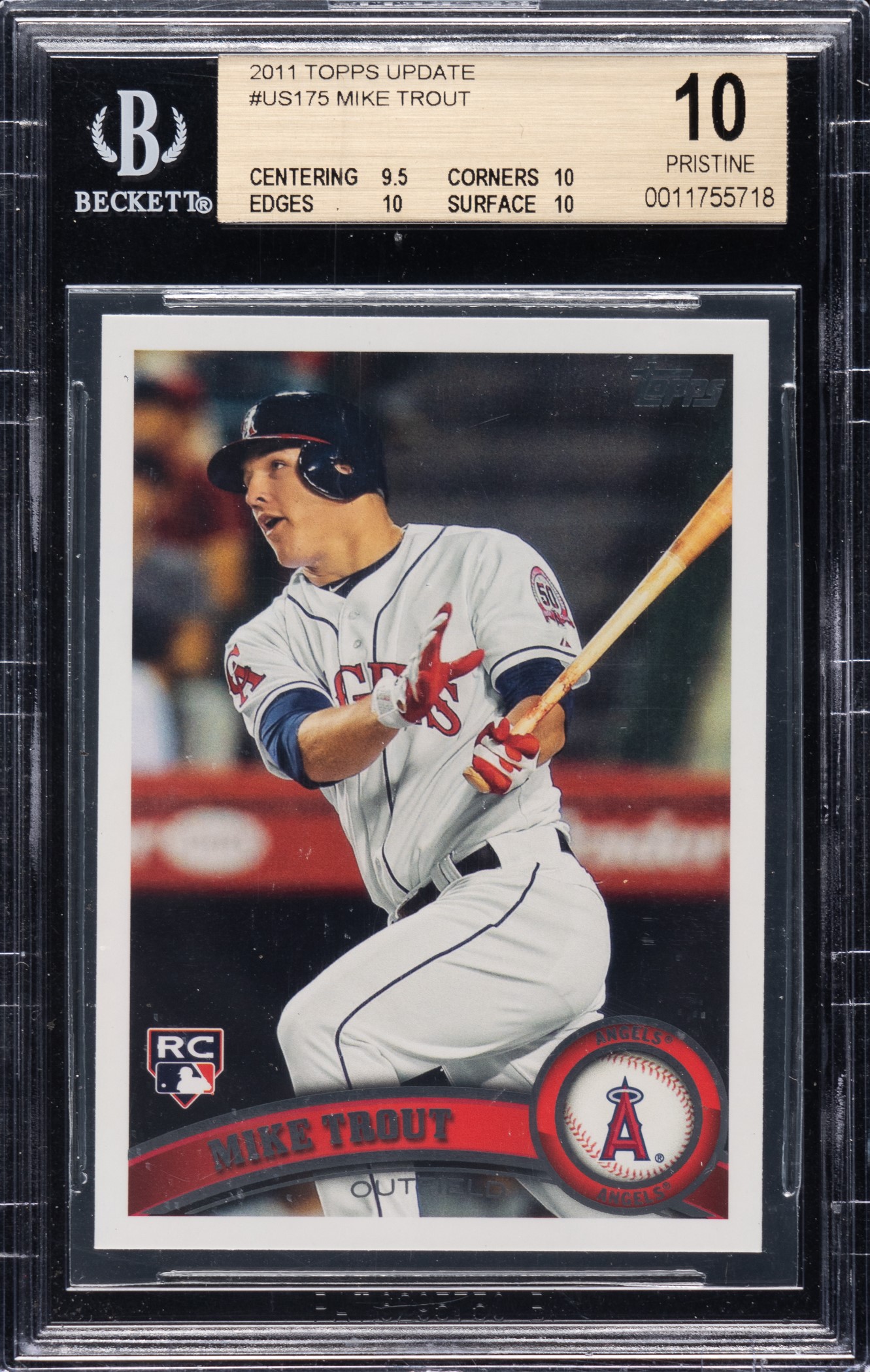
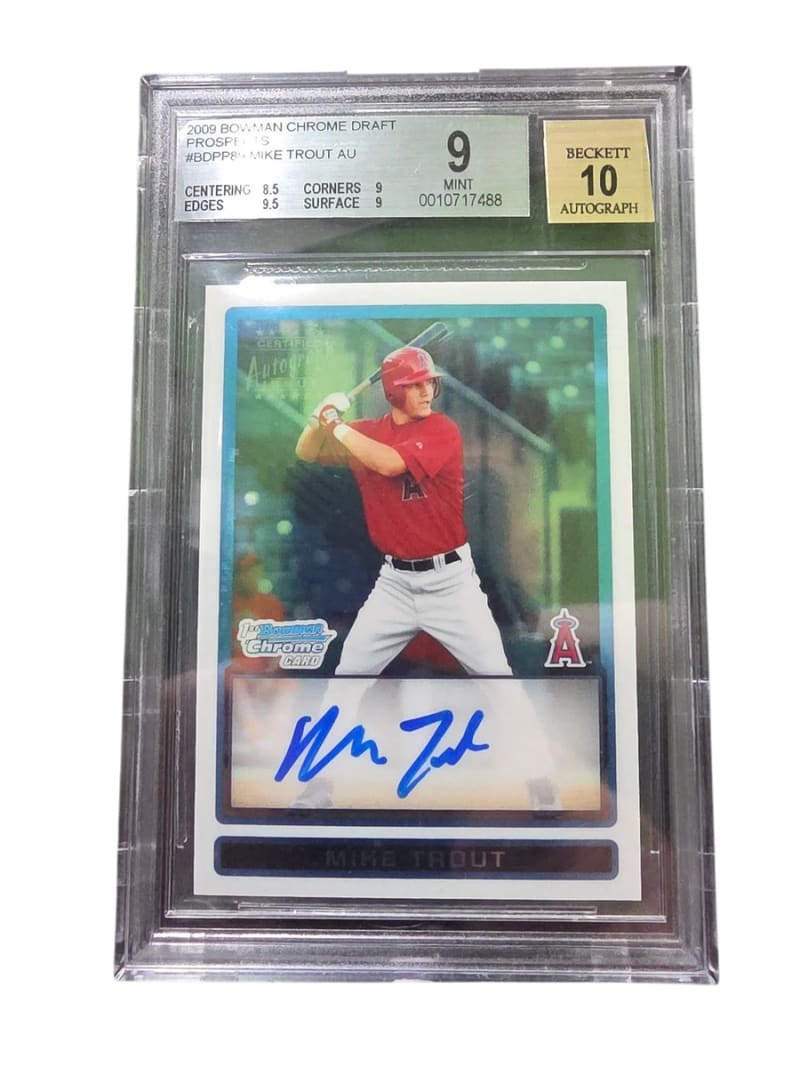
Mike Trout shows both sides. His 2009 Bowman Chrome Draft #BDPP89 predates the 2011 cards in his rookie set, and our catalog treats it as a prospect card. PSA calls his 2011 Topps Update #US175 his most popular rookie card, one of eight cards in his rookie set on the PSA Set Registry.
1st Bowman vs RC: Not the Same Card
1st Bowman
- Issued before the player's flagship RC
- His first card as a professional prospect
- Stamped "1st Bowman"
- Shows him in the uniform of the pro team that drafted him
Official RC
- Issued after the player's MLB debut
- Requires an appearance in an official game
- Carries the RC stamp
- Lands in Series 1, Series 2 or Update depending on timing
Both columns come from Topps. Topps also concedes the debate: some collectors call 1st Bowman cards the true rookie cards, others wait for the RC logo, and Topps says what counts as the "true" rookie depends on the collector. The official definition is not in doubt, though. A 1st Bowman card is a prospect card, not an RC. Our Topps Chrome rookie trends post covers how the market treats the two.
XRC and the "Update Rookie"
PSA's glossary dates the traded set to Topps in 1981: a set, usually factory packaged, featuring players who switched teams during the season and players who made their debuts. Fleer called its version "Update" and Score called its version "Rookie/Traded." PSA's profile of the 1986 Topps Traded set says it was distributed only as a factory set.
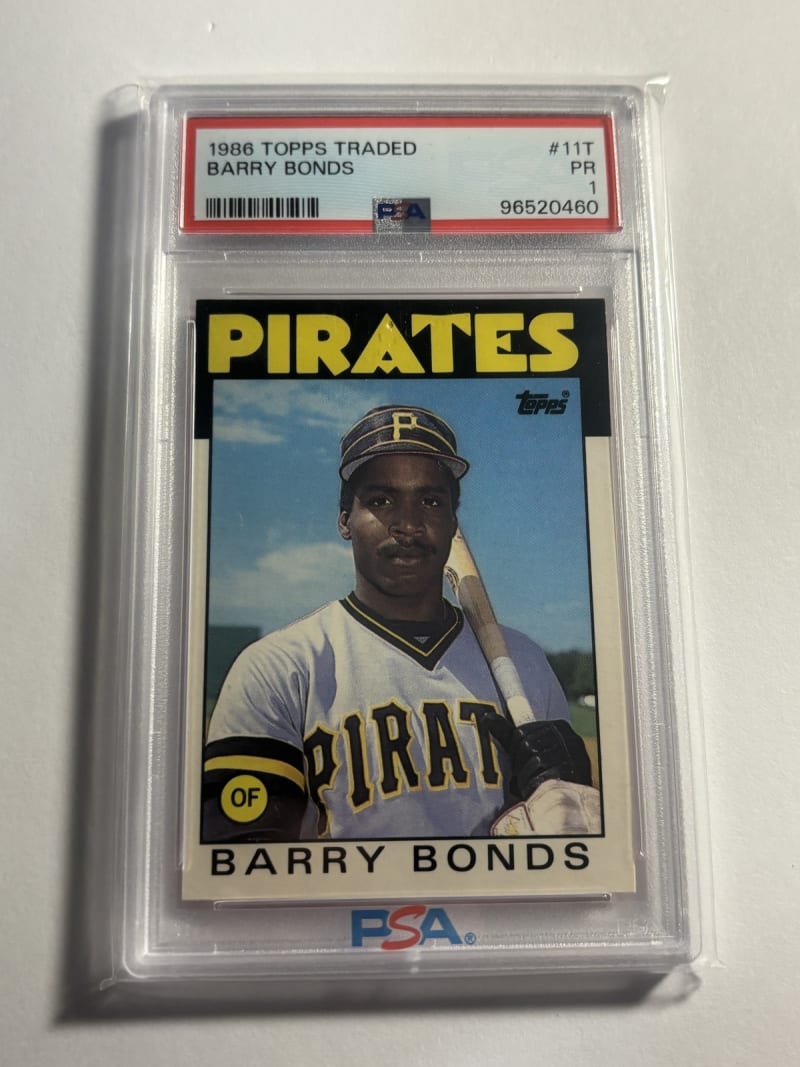
That distribution is why the label XRC (extended rookie card) exists. BaseballCardPedia describes XRC as Beckett's term for a rookie card from a 1980s extended or traded set, adopted because some collectors doubted whether cards sold through hobby channels instead of packs were true rookies. It says the label was discontinued after 1988, that existing XRCs were grandfathered, and that Beckett revived it in 2001 for the Donruss Elite Extra Edition cards. A card such as the 1986 Topps Traded Barry Bonds #11T comes from exactly that kind of factory-only 1980s set, and BaseballCardPedia names it as one of that set's key XRCs. It also says the hobby generally treats a player's XRC and his first regular-set card as rookies alike, so our catalog keeps the Bonds card among its rookies and labels it XRC.
"Update rookie" today means something different and less controversial. Topps Update Series is one of the three products where Topps places official RCs, so a modern Update card with the RC logo is a full rookie card, not an extended one.
What Grading Labels Tell You (and Don't)
A slab confirms which card you have. It is a weaker guide to whether that card is a rookie.
PSA
PSA says its Research Department confirms each card's year, brand, number, subject and any error or variation for the label, within a fixed number of characters per line. Rookie status is not one of the items it lists. PSA's own glossary defines a rookie card loosely, as a player's first year of cards whether or not it is his rookie season, and notes a player may have one or dozens.
CGC
CGC's glossary defines a rookie card (RC) as a player's first officially licensed card after making the roster of a major-league team. For its registry, CGC is stricter: a rookie card is a player's first base card in a regular issued, fully licensed set, and it cannot be an insert, parallel or redemption card. The CGC pages we read do not describe a rookie marking on the label itself.
SGC
We could not confirm SGC's rookie labelling practice from SGC's own published pages, so this guide makes no claim about it.
The practical takeaway: use the label to pin down the exact year, set, number and variation, then check that identity against the player's recognized rookie list. For choosing a grader in the first place, see PSA vs SGC vs CGC and how to submit cards for grading.
How to Check a Card
- Find the year. For 2006 and later sets, official rookie cards carry the RC logo on the front, so look for it first.
- Look for a "1st Bowman" stamp. That marks a prospect card issued before the debut, not an RC.
- Confirm it is a base card. CGC's registry excludes inserts, parallels and redemptions from rookie sets.
- For pre-2006 cards, check the checklist. Is it the player's first licensed base card for that brand? Did he already have cards in earlier releases?
- Note 1980s Traded and Update sets. These factory-set rookies are the cards the XRC label was created for, and some references still treat them separately.
- Read the slab, then compare. Match the label's year, set, number and variation to the player's recognized rookie list, such as a grader's registry rookie set.
How SluggerData Marks Rookies
Our catalog stores rookie status as a yes or no flag on each card. The flag is set from a hand-checked list of cards we treat as a player's recognized rookie cards; anything not on the list stays unflagged, and when a card is in doubt we leave it off. A flagged card shows an RC badge in the card grid on the catalog and on player pages, is labelled "Rookie card" on homepage card tiles, and is included by the Rookie Cards filter, the rookie value guides and the key rookies list on set pages.
Extended rookie cards from the 1980s factory sets stay flagged but carry an XRC badge instead, and read "Extended rookie (XRC)" on card tiles. Today that covers three cards: the 1986 Topps Traded Barry Bonds, the 1986 Donruss The Rookies Will Clark and the 1988 Donruss The Rookies Edgar Martinez. A traded-set card of a player who was already in that year's regular set is not a rookie at all: the 1982 Topps Traded Cal Ripken is famous, but his rookie is the 1982 Topps #21, so only #21 is flagged. The same goes for Greg Maddux: his 1987 Donruss #36 is flagged, and his 1987 Topps Traded card is not.
The examples in this post follow the definitions above. The 1951 Bowman Mantle is flagged and the 1952 Topps Mantle is not. Trout's 2011 Topps Update is flagged and his 2009 Bowman Chrome Draft prospect card is not. A player can have more than one flagged card: Ken Griffey Jr. has five, from 1989 Upper Deck, Topps Traded, Donruss, Fleer and Bowman.
Two limits are worth stating plainly. The flag is our editorial judgment, not a grader's or the MLBPA's ruling, and it is not read from the logo on the card. And it only decides where a card is listed and how it is labelled: it does not change any sold-comp figure. How those figures are built is on our methodology page.
Browse Rookie Cards in the Catalog
Turn on the Rookie Cards filter to see every card we flag as a recognized rookie, each with its recorded eBay sold comps by grade.
Browse Rookie CardsFrequently Asked Questions
What does the RC logo on a baseball card mean?+
It marks the card as an official rookie card. Topps describes a rookie card as a player's first card after his MLB debut, designated with the small RC stamp in the corner. Sports Collectors Digest reported that the logo was to appear beginning with all 2006 sets, as part of rookie card changes described by the MLBPA.
Is a 1st Bowman card a rookie card?+
Not under the official definition. Topps says a player gets a 1st Bowman card before his official flagship RC: it is his first card as a professional prospect and is stamped "1st Bowman." Some collectors still call it the "true" rookie, and Topps itself says that debate comes down to the collector.
What is an XRC?+
XRC stands for extended rookie card. BaseballCardPedia describes it as Beckett's term for a rookie card from a 1980s extended or traded set, a label that was discontinued after 1988, with existing XRCs grandfathered, and revived in 2001 for Donruss Elite Extra Edition cards.
Do older cards without an RC logo count as rookie cards?+
Yes. The logo only dates to the 2006 sets, so earlier rookie cards never carried it. PSA calls the 1951 Bowman Mickey Mantle #253 the only recognized rookie card of Mantle, and it has no logo. For pre-logo cards, collectors rely on hobby consensus and checklists instead.
Sources
Each source was read on November 18, 2026.
- Topps (Ripped), MLB Rookie Card Crash Course, Part One: What’s a Rookie Card? (Alex Giaimo, September 30, 2024)
- Sports Collectors Digest, Estimating the rookie-card rule impact (Rocky Landsverk)
- Cardboard Connection, Baseball Rookie Cards: Definitive Guide to Rookies and Prospects (Ryan Cracknell)
- PSA, Lingo (hobby glossary: rookie card, RC, traded set, update set)
- PSA, PSA Update: The Challenges of Grading Ultra-Modern Trading Cards
- PSA CardFacts, 1951 Bowman Mickey Mantle #253
- PSA CardFacts, 1986 Topps Traded set profile
- PSA, PSA Set Registry Starter Kit: Mike Trout Rookie Set
- CGC Cards, Sports Card Grading Glossary: Rookie Card (RC)
- CGC Cards Registry, Baseball Rookie Player Sets (set type definition)
- BaseballCardPedia, XRC
- BaseballCardPedia, 1986 Topps Traded
- BaseballCardPedia, 1986 Donruss The Rookies
- BaseballCardPedia, 1988 Donruss The Rookies
- BaseballCardPedia, 1982 Topps Traded
Featured on SluggerData
Verified sold-price comps and graded listings for the cards and players in this article. Population data is shown only when it is available in the catalog.